
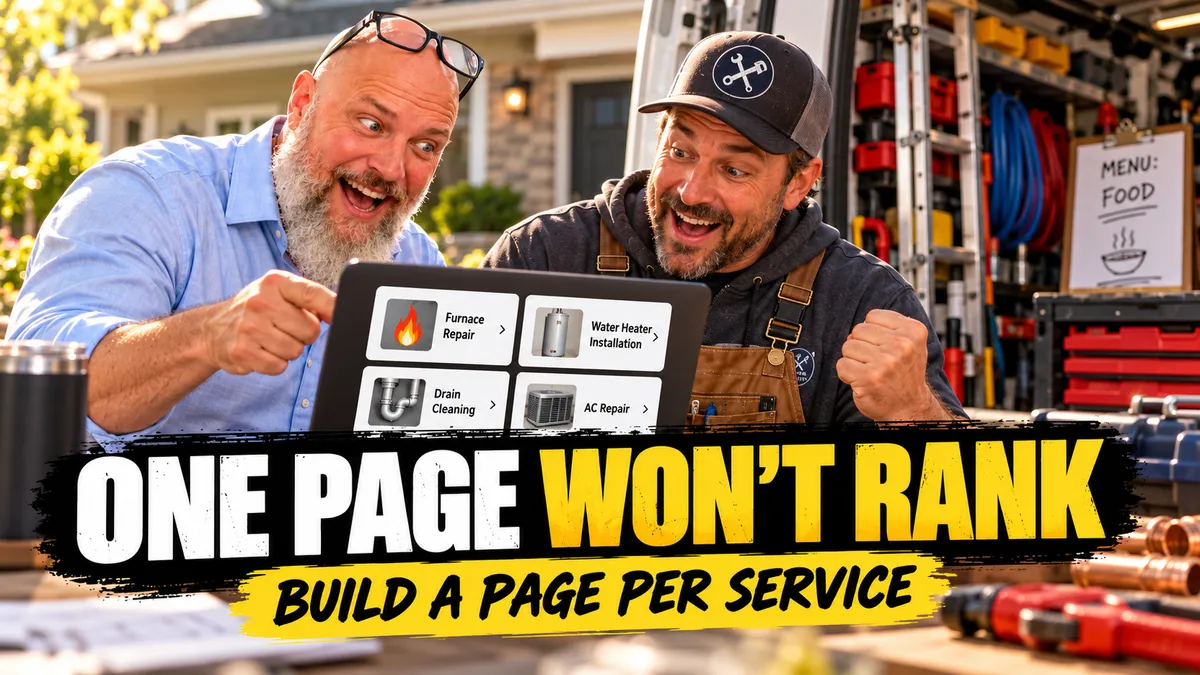
One 'Services' Page Isn't SEO: Build a Page Per Service
Picture this. A homeowner's water heater just died. It's 6 a.m., the shower is a cold-water confession, and they're typing "tankless water heater installation near me" into Google with one eye open and zero patience.
Now picture your website. Specifically, that one page in your menu called Services. It says something like, "We offer a wide range of quality solutions tailored to your needs."
Google reads that and shrugs. Your customer reads that and shrugs harder. Then they tap the back button and call whoever has a page that says exactly what they need.
If you run a service business and your website has one big, catch-all Services page, this one's for you. I say that with love, because I've built that page myself. It felt efficient. It felt tidy. It was quietly costing me leads.
The Problem: Your Website Says "We Do Everything" (and Google Hears Nothing)
Here's the thing most service business owners don't realize: Google ranks pages, not businesses. Every page on your site gets a shot at showing up for a specific search. When one page tries to cover installs, repairs, maintenance, emergency calls, and commercial work, it ends up being a little bit about everything and a lot about nothing.
It's the website version of a restaurant menu that says "Food." Technically accurate. Completely useless.
And it's not just a search engine problem. It's a human problem. Your customer didn't wake up thinking, "I need a provider of comprehensive solutions." They woke up thinking, "My furnace is making a noise like a haunted accordion." They want the page that talks about that.
Why One Big Services Page Quietly Costs You Leads
A catch-all Services page creates three leaks at once:
- It's unclear to search engines. One page can only be the best answer to so many questions. Split your services across dedicated pages and each one can target the exact thing people search for.
- It's overwhelming to visitors. When someone has to scroll through a wall of bullet points to find their problem, a lot of them simply won't. Confused people don't buy. They leave.
- It dilutes your call to action. A page about everything can't have one clear next step. A page about one thing can: "Book your furnace repair." Done.
Inconsistent leads often aren't a traffic problem. They're a clarity problem. People are finding you, but your site isn't telling them fast enough, "Yes, we do that, here's how it works, and here's what to do next."
The "One Page, One Problem" Framework
Good news: you don't need to rebuild your whole website or learn a new language called Technical SEO. You need a simple rule. One page, one problem solved. Here's how to apply it.
Step 1: List the services that actually pay the bills
Grab a coffee and write down every service you offer. Then circle the ones that bring in the most profit, not just the most work. (Those are different lists, and the difference can be painful.) Start with your top three to five. You can build out the rest later.
Step 2: Give each service its own page and a plain-English title
Ditch titles like "Solutions" or "What We Do." Use the words a real person would type into a search bar. "Drain Cleaning in [Your City]" beats "Plumbing Excellence" every single time. Put the main service and the area you serve in the page title and the main headline, and keep your web address short and clean.
Step 3: Talk like your customer, not your brochure
Open each page by describing the problem the way your customer would. "Your basement is wet and you're not sure why" will earn more attention than "We provide industry-leading waterproofing." When people feel understood in the first two sentences, they keep reading. That's the whole game.
Step 4: Answer the questions that make people nervous
Every service has the same unspoken worries: How much will this cost? How long will it take? Will you show up when you say you will? Address them head-on with a short process section, a realistic timeline, and an honest note about what affects price. A good FAQ at the bottom of the page helps real humans and gives search engines more helpful, relevant content to work with.
Step 5: Add proof and one clear next step
Drop in a testimonial or a before-and-after that matches that specific service, then finish with one obvious action: call, book, or request a quote. Not five options. One. Decision fatigue is real, and it's the enemy of your phone ringing.
A Simple Service Page Blueprint You Can Copy
If you want a template, steal this structure for each page:
- Headline: the service plus who it's for or where (for example, "Emergency Furnace Repair for Homeowners in Kelowna").
- Problem paragraph: describe the situation in your customer's own words.
- How it works: three to four simple steps from first call to finished job.
- Why us: two or three specifics, like response time, guarantees, or certifications.
- Proof: one relevant review or result.
- FAQ: four to six real questions your customers ask.
- Call to action: one button, one phone number, one form.
Mistakes That Make Service Pages Flop
- Copy-pasting the same page for every town. Changing "Kelowna" to "Vernon" and calling it a day isn't strategy. It's a cry for help. Make each page genuinely useful.
- Cramming 14 services into one accordion menu. Tidy for you, tiring for them.
- Hiding your phone number or booking button. If people have to hunt for it, they won't.
- Writing for yourself. If your page sounds like an industry conference, your customer is already gone.
Make Every Page Part of a Connected System
Here's where it gets fun. A service page shouldn't be a lonely digital brochure. It should be the front door to a system. Someone lands on your "Kitchen Renovation" page, fills out the form, and instantly gets a confirmation, a booking link, and a friendly follow-up. The lead lands in your pipeline, nothing slips through the cracks, and you're not chasing people at 9 p.m. with a sticky note.
That's what a connected marketing system does. Clear messaging brings the right people in, dedicated pages help them say "yes, that's me," and automation makes sure none of them get ignored. When your website, forms, follow-up, and pipeline all talk to each other, leads stop being a mystery and start being predictable.
Your 30-Minute Homework
Don't wait for a "someday" website overhaul. Do this today:
- Open your current Services page and count how many different services it tries to cover.
- Pick the one that makes you the most profit.
- Write a headline for it using the words your customer would actually search.
- Draft the problem paragraph, three steps, and one call to action.
That's it. One page. If it brings in even one extra good customer, you'll want to build the next one. (Fair warning: it's mildly addictive.)
Ready for a Website That Tells People (and Google) Exactly What You Do?
At Black Mountain Media, we help service businesses attract profitable customers with clear messaging and a connected marketing system, so your website, your follow-up, and your pipeline finally work as one team. If your leads feel inconsistent and your website feels like it's mumbling, let's talk. We'll help you get clear on what you offer, who it's for, and how to turn more of those visitors into booked jobs.
Reach out to Black Mountain Media today and let's turn your Services page into a lead-generating machine.
- Mike Cooper, Founder, Black Mountain Media






Mail
Facebook
LinkedIn
X
Pinterest